
Revit Structure
Client :
Precast concrete contractor
Project Type :
Precast Structural BIM Modeling & Coordination
Location :
Dubai (UAE)
Service Provided :
BIM Associates provided end-to-end Precast BIM Services
Project Overview
This project was undertaken to support a U.S based precast concrete manufacturer in improving operational efficiency, cost control, and on-site erection planning through BIM implementation. The client required a robust BIM solution to model multiple box culverts and precast structural components while embedding critical data such as weight, dimensions, and identification details directly into the model.
BIM Associates developed a highly detailed Revit-based structural model with strict tolerance rules to accurately represent gaps and alignments between precast elements. Each component, including reinforcement, was modeled to ensure compliance with weight limitations and lifting constraints. Special attention was given to the symmetrical placement of lifting bars to avoid imbalance and safety risks during erection.
All connections were modeled directly in 3D, eliminating ambiguity during fabrication and installation. Each precast element was assigned a unique ID linked to QR codes, which were reflected in erection floor plans to streamline transport, identification, and on-site placement. Typical components were identified and coordinated with the client’s team to enable maximum mould reuse, significantly reducing mould production costs and casting time.
Comprehensive clash detection was carried out across structural, architectural, and MEP disciplines to ensure constructability and eliminate conflicts prior to execution. The final BIM model enabled accurate BOQ generation, improved crane and lifting equipment planning, and reduced on-site delays related to coordination. Overall, the project delivered measurable improvements in construction speed, cost savings, safety, and return on investment (ROI) for the client.
The Client is a precast concrete contractor, he is specialised in precast concrete building erection and assembly.
The client is a concrete contractor based in Dubai, they specialize in Precast Concrete and assembly.
- Client wanted to check weight of each precast element, as construction site has certain limitation with respect to lifting equipment’s and access roads.
- Client also wanted, some way to ease out his erection process.
- Client wanted to save money by maximizing moulds for multiple elements.
- Detailed BOQ and Connections details were to be made.
Observation of requirements, workflow, and changes in the given project in the timeline by the project team at BIM Associates, highlights below challenges.
- As the structure was precast, Gaps between structural elements were be precisely maintained in Revit Model also. Rules and very stringent.
- Each Structural element with concrete and rebar should not weight more than 20 tonne.
- The lifting bars should be in proper symmetry, un balance lifting bars may cause damage to structural element or create any accident on site.
- Co ordination with other disciplines added to this challenge.
- BIM Team at BIM ASSOCIATES developed a detailed Revit Structural Model with all preset rules for spaces between precast elements.
- All Connections were detailed in 3d model itself. Each structural elements was given unique ID number, which will be later printed on a QR code and will reflect the same on erection floor plan.
- This will made transport, erections smooth.
- All typical set of structural elements were highlighted with client design team, so they can use same mould for casting multiple structural elements and tag them with respect to their unique ID.
- This helped client in saving cost and valuable time in casting and transporting.
- Each element and its weight was checked in Revit and confirmed with client to keep its overall weight under 20 Tonne.
- Full Clash resolution was done with other disciplines.
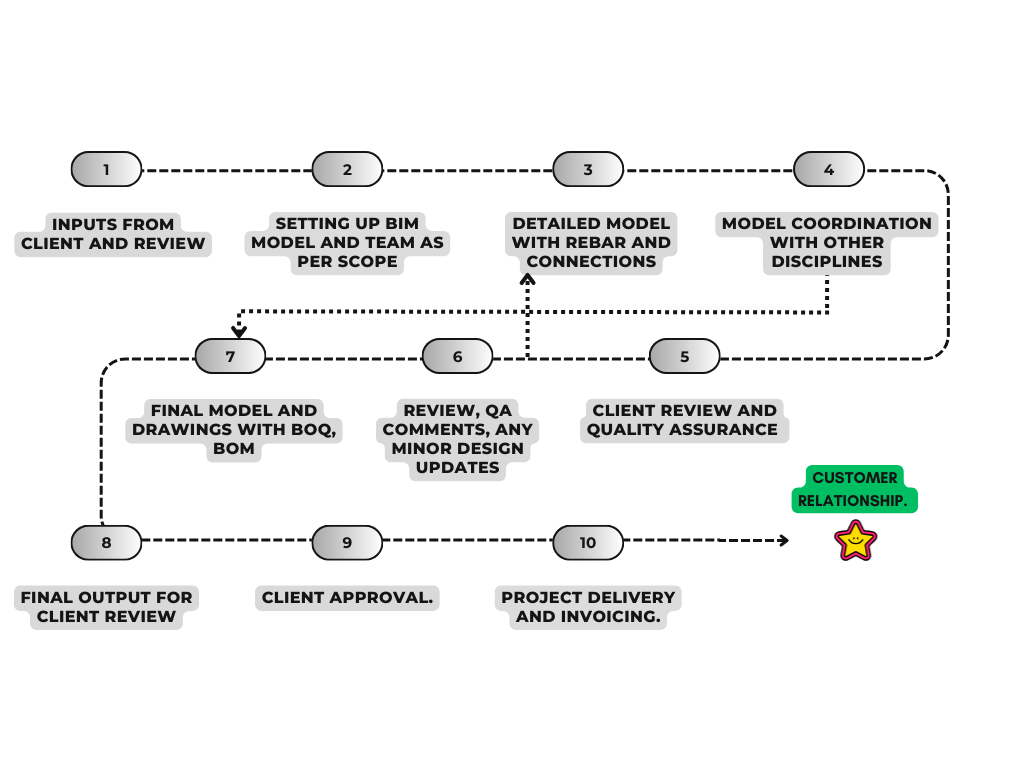
On finalizing the scope and deliverables needed with the client team, below is the flow/approach that our team has used :
- Team with dedicated Project Lead, built a detailed Revit Structural model as per specification and norms given by client design team.
- Each elements was detailed and connections were added to the same in Revit model.
- Once re-baring was done, the weight of the structural elements, clash in any rebar or connection was verified and discussed with client structural design team.
- Once this was done unique ID was given to each structural member, the same ID with be mentioned in erection plan for easy assembly on site.
- Full clash resolution was done with other disciplines, with internal connections so accurate model and bill of quantities can be extracted.
- Typical list of elements were identified and highlighted to client with respect to size and count.
- This help client in overall manufacturing, transport and erection of the building members.
- Also time and material saving was done, which helped in improving overall ROI of the project.
The below is a basic workflow for project. Please note fine details on the same are not shown here.
Autodesk Revit, AutoCAD, PyRevit
- Cost Saving and tight turnaround.
- Core expertise and Pro data Utilization.
- Better Skill and Resource Planning for Business Success.
- Flexible working hours for best project needs.
- Client was able to offer an added package to its end customer, this help our client to expand his business.
How does BIM help you manage and plan Site transport and lifting arrangement for the precast structural element’s erection on site?
The project requires each precast element to remain within a within a specific-tonne weight limit. BIM ASSOCIATES develops a detailed Revit structural model incorporating accurate element geometry, reinforcement, precast allowance gaps and connection information which allows individual element weights to be reviewed during the modelling and detailing stage, supporting transportation and lifting planning before fabrication. Lifting bars and lifting points are also coordinated symmetrically based on the element geometry and centre of gravity to support balanced lifting and reduce potential risks during transportation and erection.
How does BIM improve the coordination and erection of the precast structure?
Each precast element is modelled and detailed with accurate dimensions, reinforcement, connections, weight, and unique IDs. These IDs are coordinated with the erection floor plans and linked to the project’s RFID-based identification system. This unique IDs are coordinated with the erection floor plans, supporting the efficient manufacturing, transportation, identification, and on-site erection.
How does BIM help reduce mould production costs for the precast manufacturer?
Detailed BIM model helps identify typical and repetitive precast elements based on their size, geometry, and quantity, allowing moulds to be reused across multiple components and tag them separately as per their erection sequence. This will help factory in best utilization of moulds, achieve casting speed, material use and bring down overall material cost and factory operating cost.
How are precast connections and gaps between structural elements coordinated in Revit?
Precast connections, interfaces, and required gaps are modeled directly in 3D using project-specific rules and stringent tolerance requirements to accurately represent these spaces. This provides the team with a more reliable representation of how structural components would connect and assemble on site and also helps identify potential issues early and improve fabrication and installation accuracy.
How does BIM coordination help identify clashes before precast fabrication and installation?
BIM ASSOCIATES carries out comprehensive clash detection using coordinated models to identify potential conflicts involving precast structural elements, reinforcement, connections, openings, and other building systems. Identified issues are reviewed and resolved with the relevant project teams before fabrication and site execution, helping reduce rework, installation conflicts, and potential project delays.
How does the Revit BIM model improve BOQ, manufacturing, and project planning?
The detailed structural model serves as serves as a central source of coordinated project information, extending its value beyond visualization and design coordination. Once precast elements, reinforcement, connections, and associated data are coordinated, the model supports accurate quantity and BOQ extraction. The same model information also supports planning for manufacturing quantities, mould requirements, transportation, lifting arrangements, and erection activities. By connecting design information with manufacturing and site planning, the BIM workflow helps in design optimization, better material planning, resource utilization, cost control, project planning, ultimately contributing to improved project ROI.


